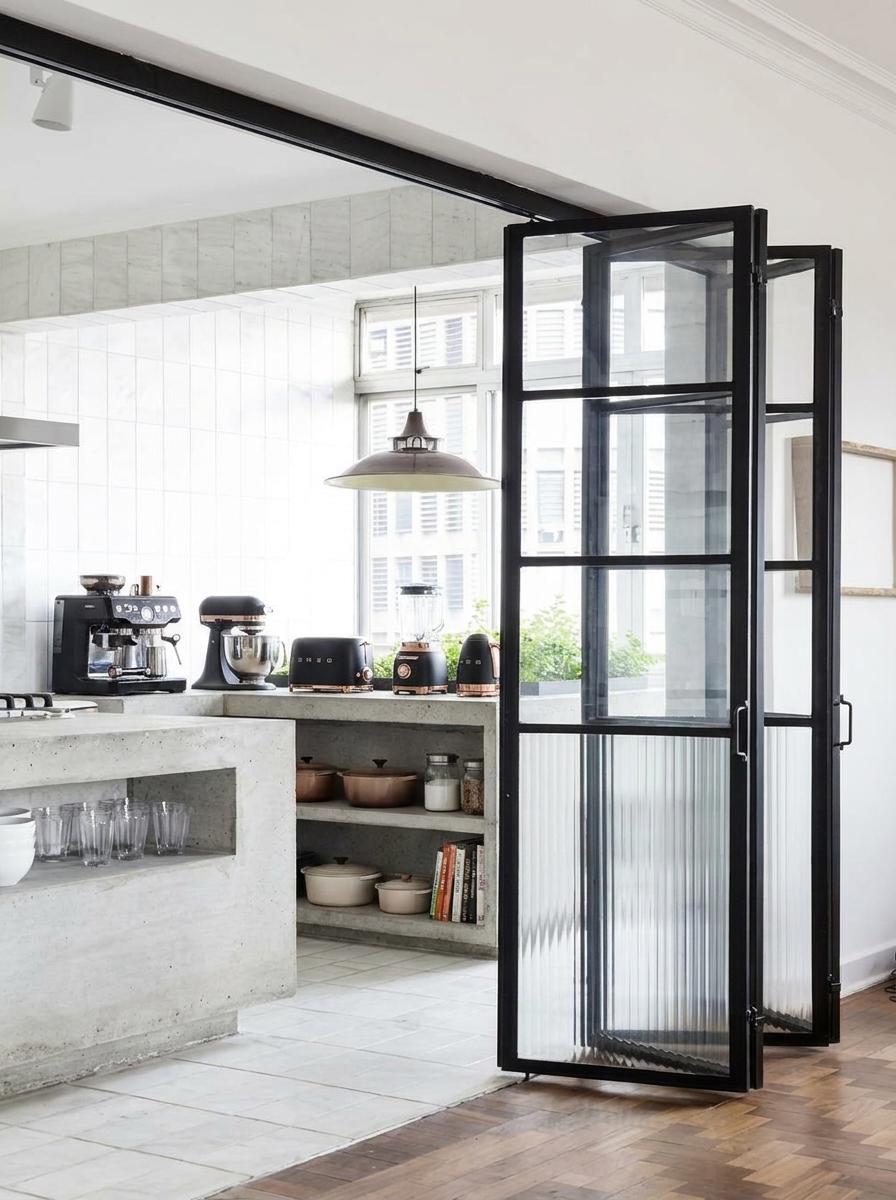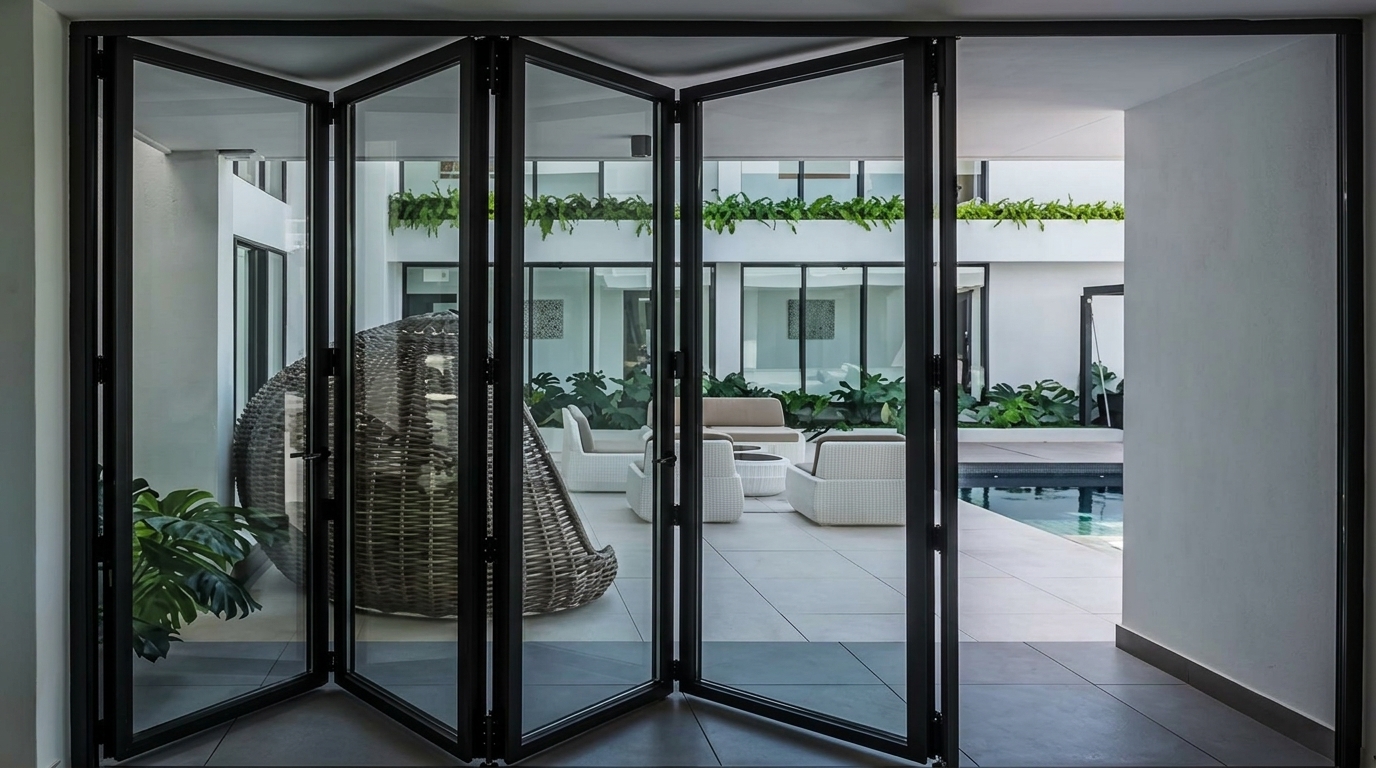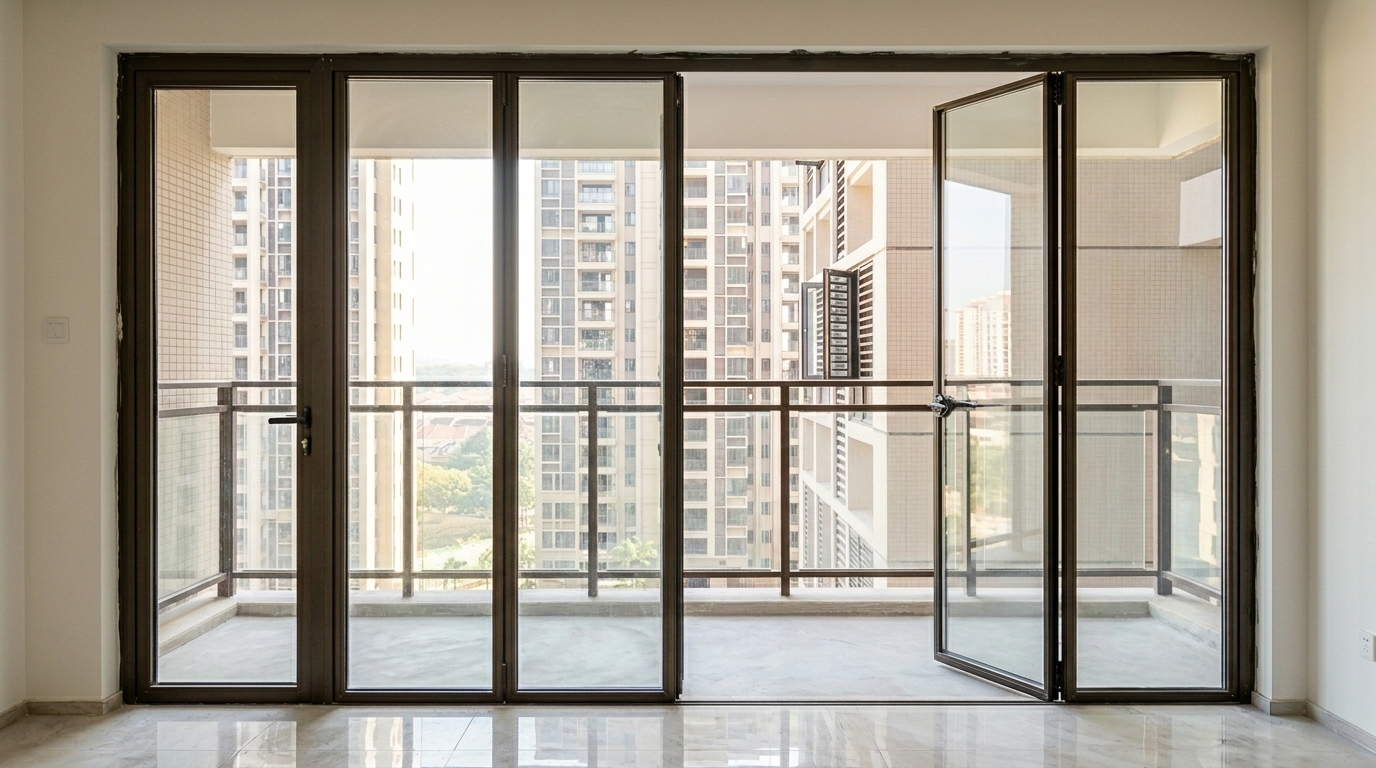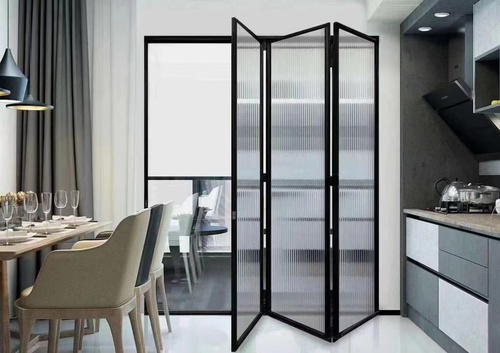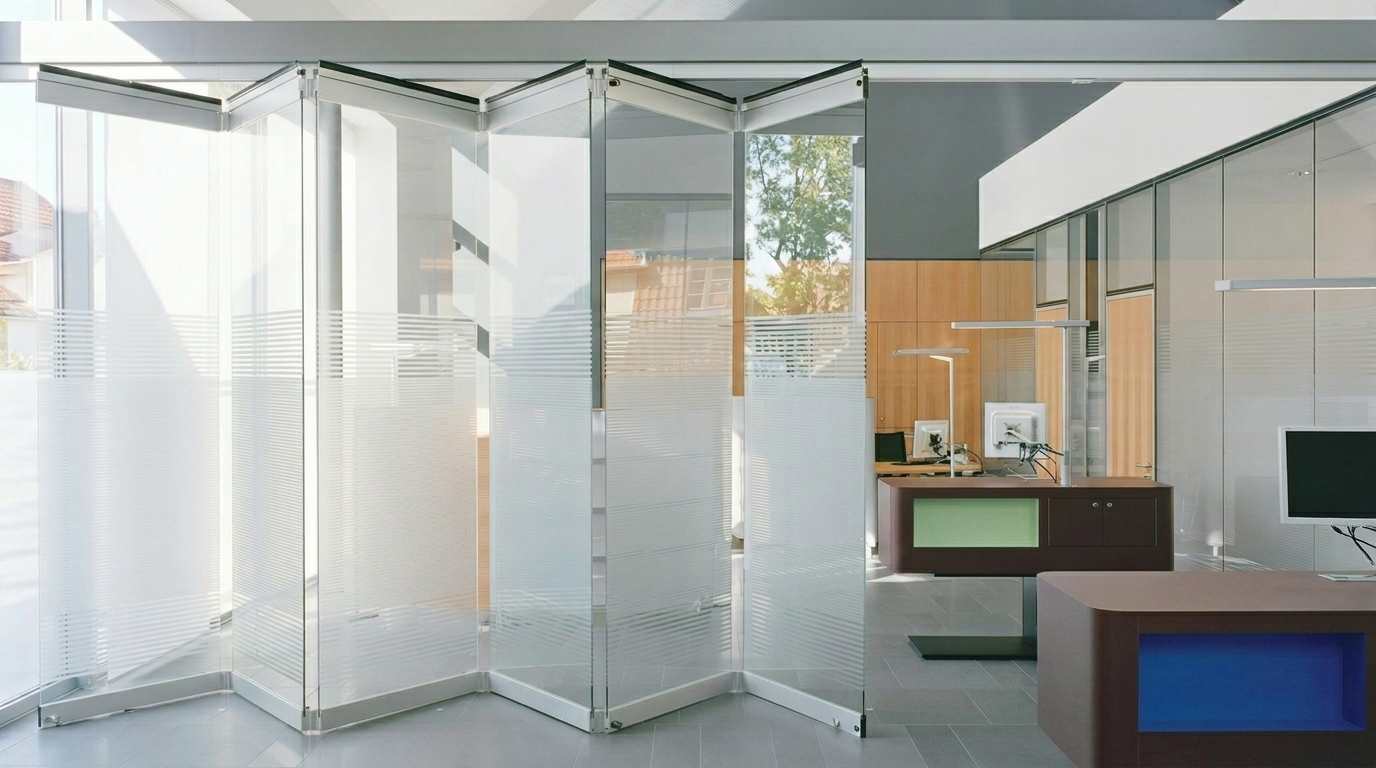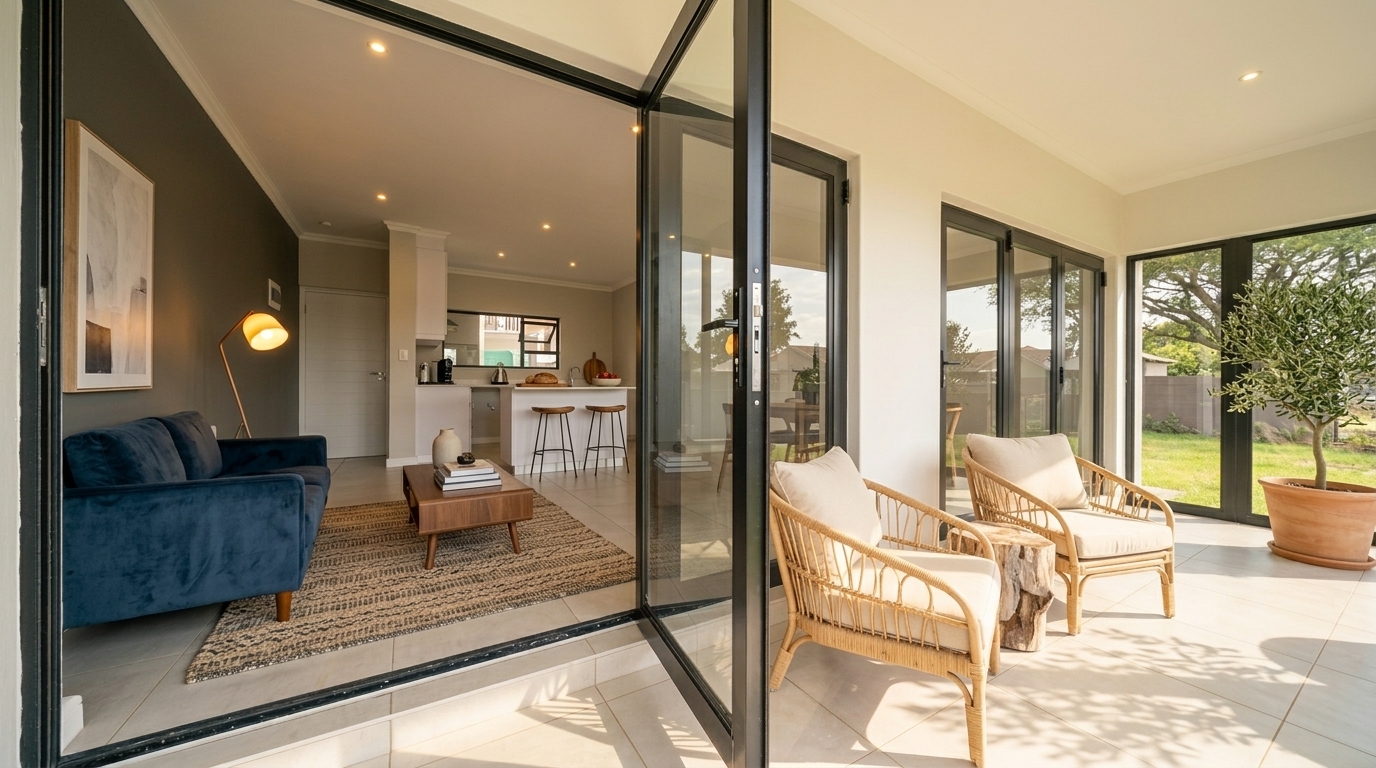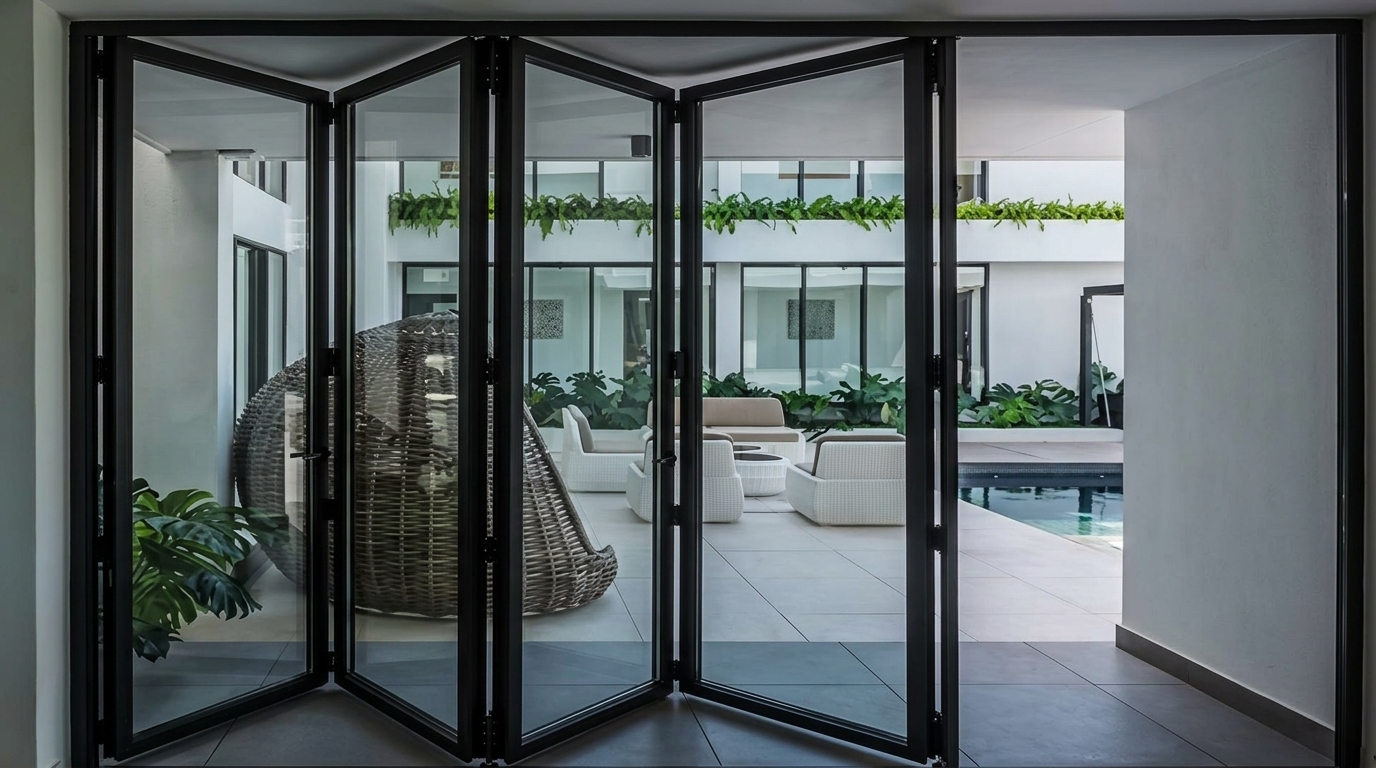
A bi-fold (concertina) door system where 3, 4 or 5 panels fold and stack against one or both ends — leaving the full opening clear. Thermal-broken frame, multipoint locking, weather-tight when shut. Built for villas and penthouses where the design intent is the wall disappears.
A villa great-room opening onto a garden. A penthouse podium meeting a terrace. A restaurant private dining opening to a balcony. The brief is the same — when the doors are open, the wall should not exist; when shut, the room should be a sealed envelope. The standard sliders never quite delivered both.
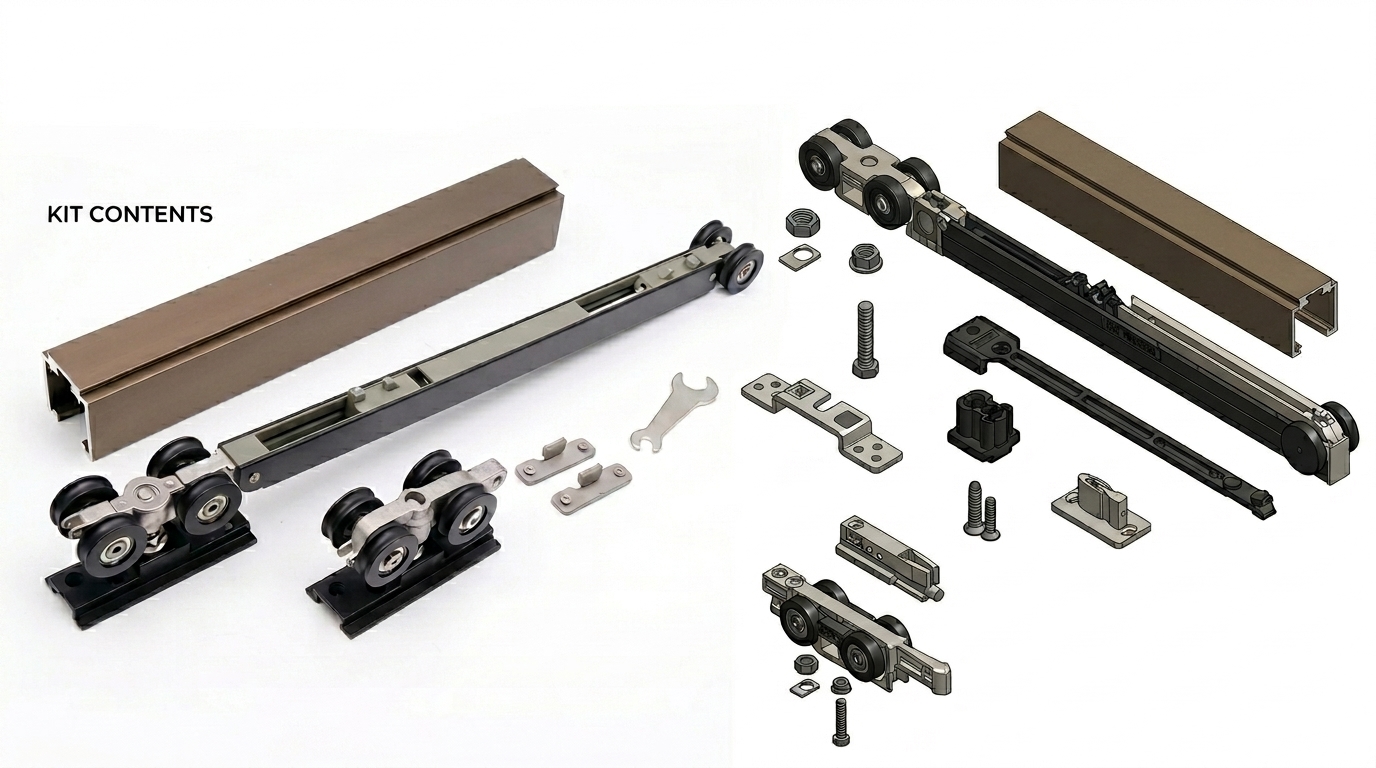
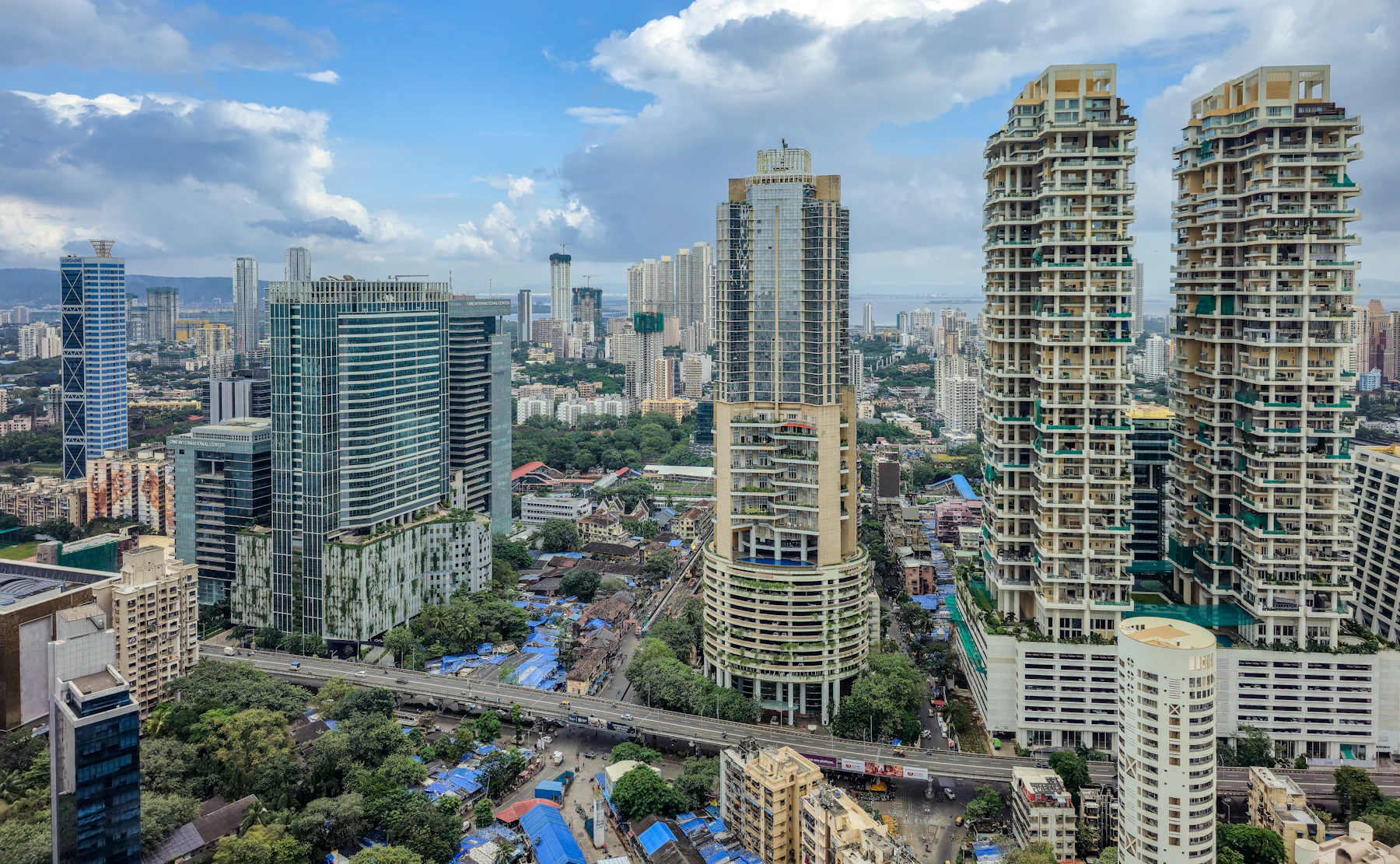
A continuous head track carries every panel on top-hung pivot rollers — the floor track is recessed flush, so nothing crosses the threshold underfoot. The thermal break inside the section keeps AC inside and Mumbai heat outside.
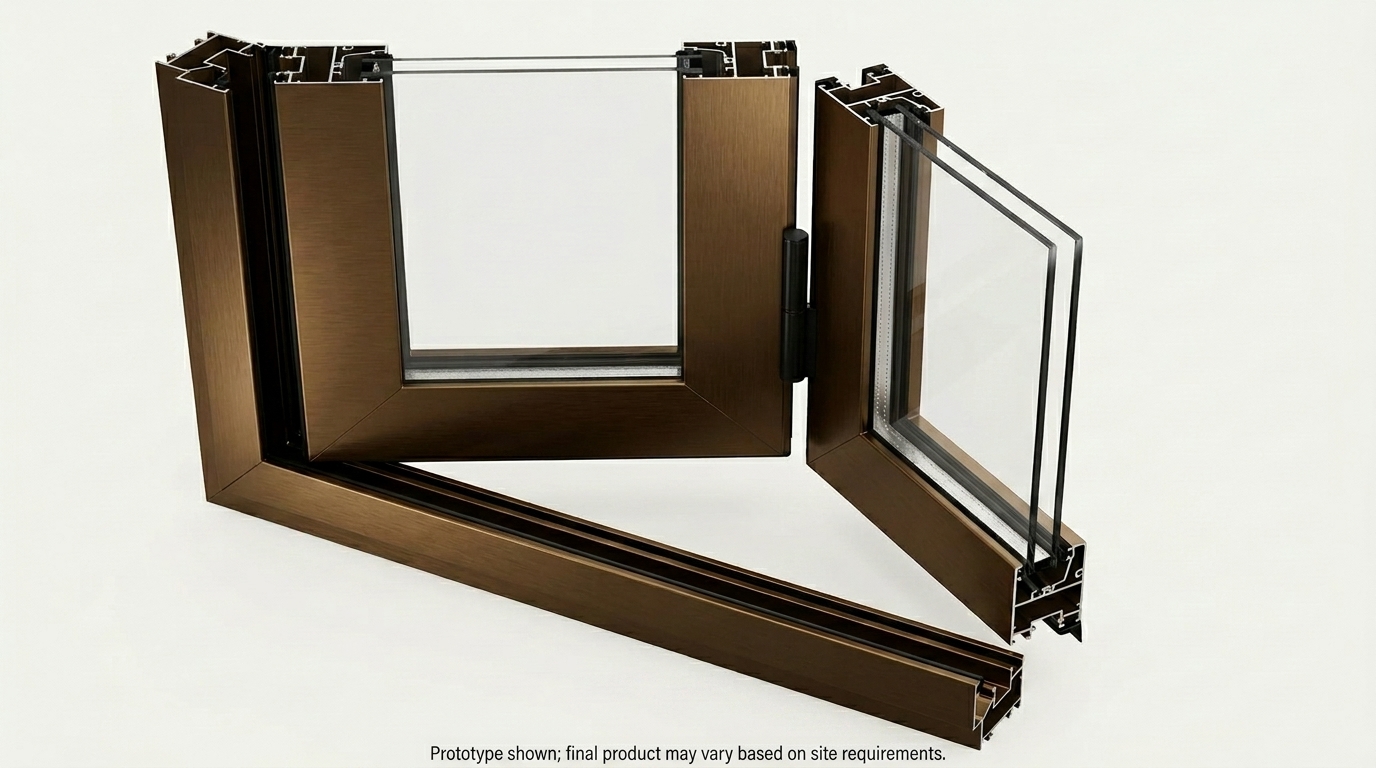
Each pair of panels is hinged together with three SS 304 hinges. Pull the leading panel and the pair folds inward, then outward, like a concertina. Three pairs make a 6-panel run; the same hinge logic scales down to 4 or 3 panels.
When the run is shut, a single lever drives a five-point lock — top, bottom, two side jambs and the leading edge — into stainless keepers. EPDM gasket on every meeting edge. The door is now a sealed envelope, not a sliding system pretending to be one.
When the door is folded back, the opening is fully clear from one jamb to the stack. Suraj walks the floor with the joinery before fabrication — the threshold detail is the part that catches most installers out, and we draw it before we cut.
A heavier section than our 16 × 45 sliders — because a bi-fold panel is asked to do more work. Thermal break for AC efficiency. Multipoint lock for security. Every hinge stainless. Every gasket continuous.
A 50 × 100 mm thermal-broken architectural aluminium profile. The polyamide thermal break inside the section cuts heat transfer — meaningful in Mumbai AC season, where a non-broken bi-fold sweats and chills the room edge in equal measure.
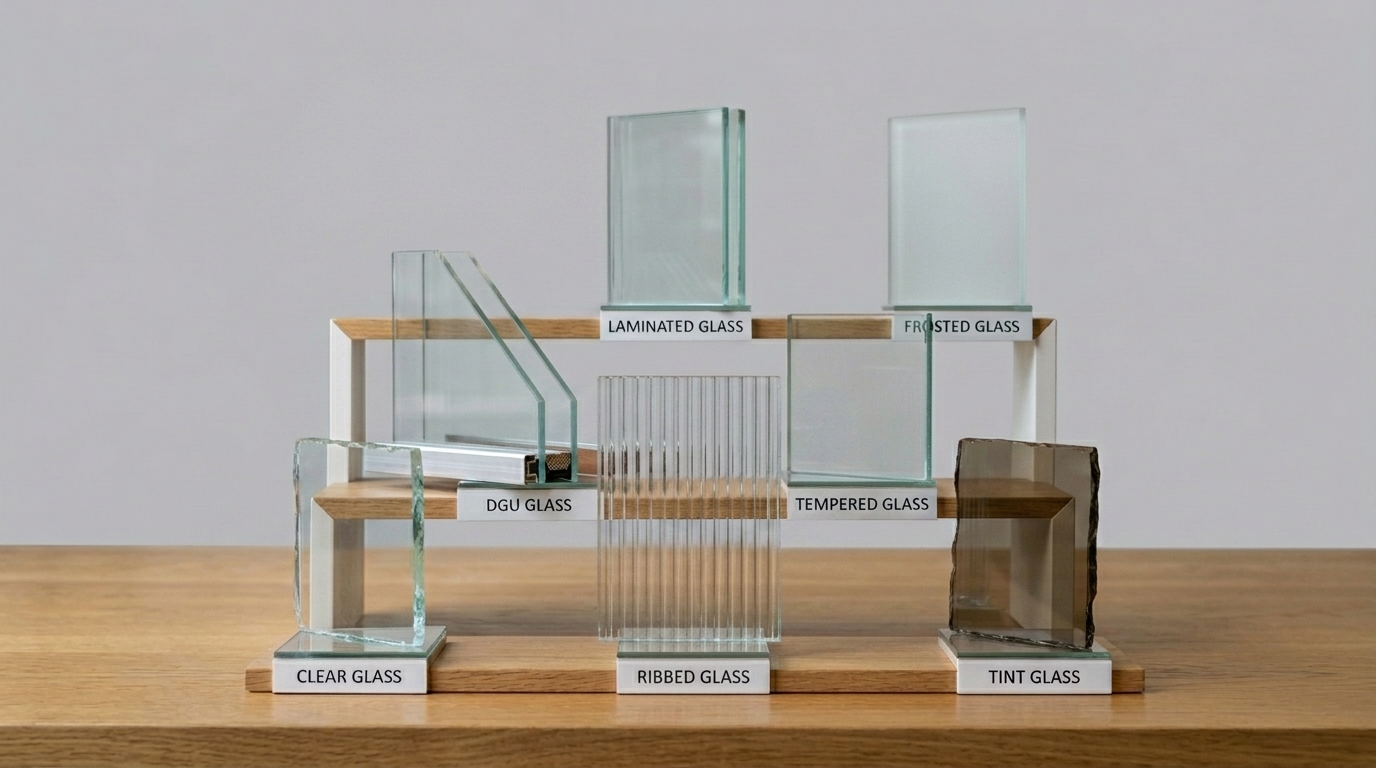
8 mm toughened on standard runs; 12 mm where panel spans cross 1.0 m or where the brief calls for a heavier acoustic or impact spec. DGU available for sound-sensitive rooms — a private cinema room opening to a podium garden, for instance.
SS 304 hinges, top-hung pivot rollers, multipoint lock gear, every fastener stainless. The lever and barrel are solid brushed stainless — no zinc-plated handle that pits in three years. EPDM continuous gasket across every meeting edge and the head and sill.
Villa great-rooms opening to gardens. Penthouse podiums meeting terraces. Restaurant private-dining rooms onto balconies. Pool-deck lounges. The bi-fold is for the moment in a project where the designer wants the boundary between inside and outside to genuinely disappear — not just visually reduce.
A 5 m great-room opening to a garden. Six panels fold and stack against the side jamb in two-pair groups. Threshold runs flush so the parquet inside meets the IPS outside without a step.
Every panel folds and stacks against the side jamb. Three-quarters of the run is fully clear; the stack itself sits roughly 200 mm proud of the jamb. The wall genuinely disappears, not visually reduces.
A single lever drives a five-point lock — top, bottom, two side jambs and the leading edge — into stainless keepers. The door is a sealed envelope when shut, with security spec that no slider can match.
A polyamide thermal break inside the 50 × 100 section stops heat from bridging through the aluminium. Meaningful on a Mumbai AC bill — and the inside of the frame stops sweating during a humid May afternoon.
EPDM continuous gasket on every meeting edge and across the head and sill. Drained head channel routes water out before it reaches the gasket line. We test the run with a hose at handover, not at first monsoon.
A 6-panel run carries on top-hung pivot rollers — no centre flying post, no tie-bar across the soffit. The opening reads as a single continuous gesture in plan and elevation.
Stack can be set against the left jamb, the right jamb, or split — three panels each side meeting at the centre when shut, parting outward when open. Drawn at shop-drawing stage, not site-improvised.
The bottom track sits flush with the finished floor — parquet, IPS or stone — so the inside meets the outside without a step. We coordinate the recess depth with the joinery before the floor screed goes down.
Mirrored shop drawing if the brief asks for the stack on the opposite end. We confirm the stack direction with the designer at drawing approval — sometimes the room reorganises and the stack moves with it.
Suraj reads the drawing. He measures the opening himself, signs off the shop drawing before fabrication, and coordinates the threshold detail with the joinery and flooring trades. No franchise, no rep.
No site-visit fee. No call-centre. No quote written before measurement. Suraj reads the drawing himself, walks the site within 48 hours of enquiry, and coordinates the threshold detail with the joinery before fabrication.
If the brief is closer to the room is a wider window, not the wall disappears, ask about the 1 fix + 3 sync slider instead — slimmer section, simpler mechanism, half the install time.